
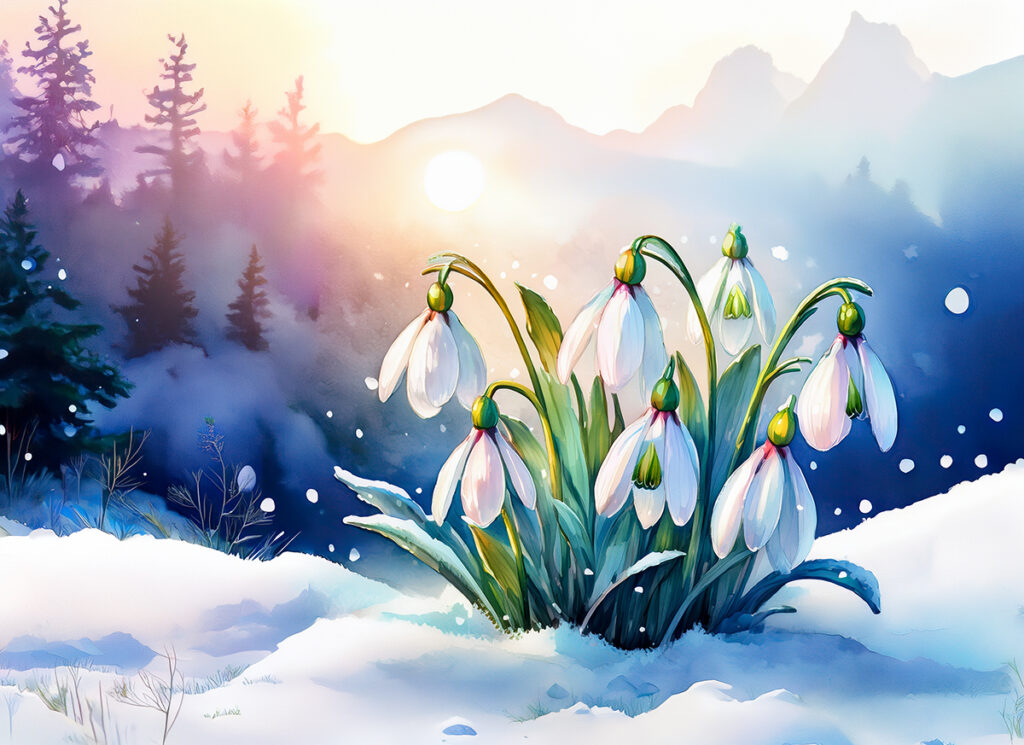
Out of the snow, lifting their heads is a clump of Snowdrops. Usually, about now, we start looking for some sign that spring is on its way. Of course, we know the seasons will bring warmth, but after a long winter of cold and snow, we look in anticipation.
There are times when we all need an encouraging, hopeful message,
delivered in kind, “old words” that remind us of forgotten memories.
Or when no words can capture what we mean, or soothe a sad heart,
the language of flowers can come to our rescue.
Kind Old Words…
Dear Friend,
As the SNOWDROPS start their ascent through the snow;
NACREAOUS is this morning when everything’s covered in FYOLE
Remember DEAR FRIEND
To LAUGH AT IT a little, as your thoughts skirt around like the FAIRYDIDLE
And you consider wandering about on this MONTIVIGANT.
Just let the PUNDERING BLOW
For surely with this little mirth
A RIDDLE is solved …and then in QUICKSTICKS
Some hopeful news, like spring flowers, can GROW.
May you have more blessed days
For Divine Grace is here always.
Original poem by Trina Astor-Stewart
Perhaps a puzzlement, with some deciphering, can be meant to cheer you in these difficult days. For kind old words bearing thoughtfulness and love. You can ponder this message of hope today. In case these old words are not in your immediate vocabulary, neither were they in mine. Yet, some old words say exactly what is meaningful today.
- Fairydiddle – like a darting red squirrel
- Montivigant – an adventure of wandering on a mountain top
- Pundering – when the wind blows the snow clean away
- Nacreaous – Iridescent light before sunrise
- Fyole – A light dusting of snow
- Quicksticks – Help will be there right away.
Flowers Hopeful Harbingers Of Spring… and when words fail, can meanings sing.
Flowers have been a special way to give a message for hundreds of years. With many having interesting and subtle meanings. Several flowers signify hopefulness. Although I believe there is a degree of hope inherent in all floral entities.
The Snowdrop… January’s official flower
Snowdrops (Galanthus nivalis), a birth flower for January, symbolize hope, purity, innocence, rebirth, resilience, consolation, and a fresh start. They appear among the first flowers in late winter, poking their white, translucent heads through the snow in spite of the cold. The Carnation is also an official flower for January.
If you have a January birthday, you probably have a resilient personality, with a forward-looking, optimistic nature and a tendency to bring positive change. I have a friend who was a January babe, and this epitomizes her to a “T”. Culturally poised and unexpected, they bring rebirth and hope to everyone.
February’s Flowers: The Violet, the Primrose, and the Iris.
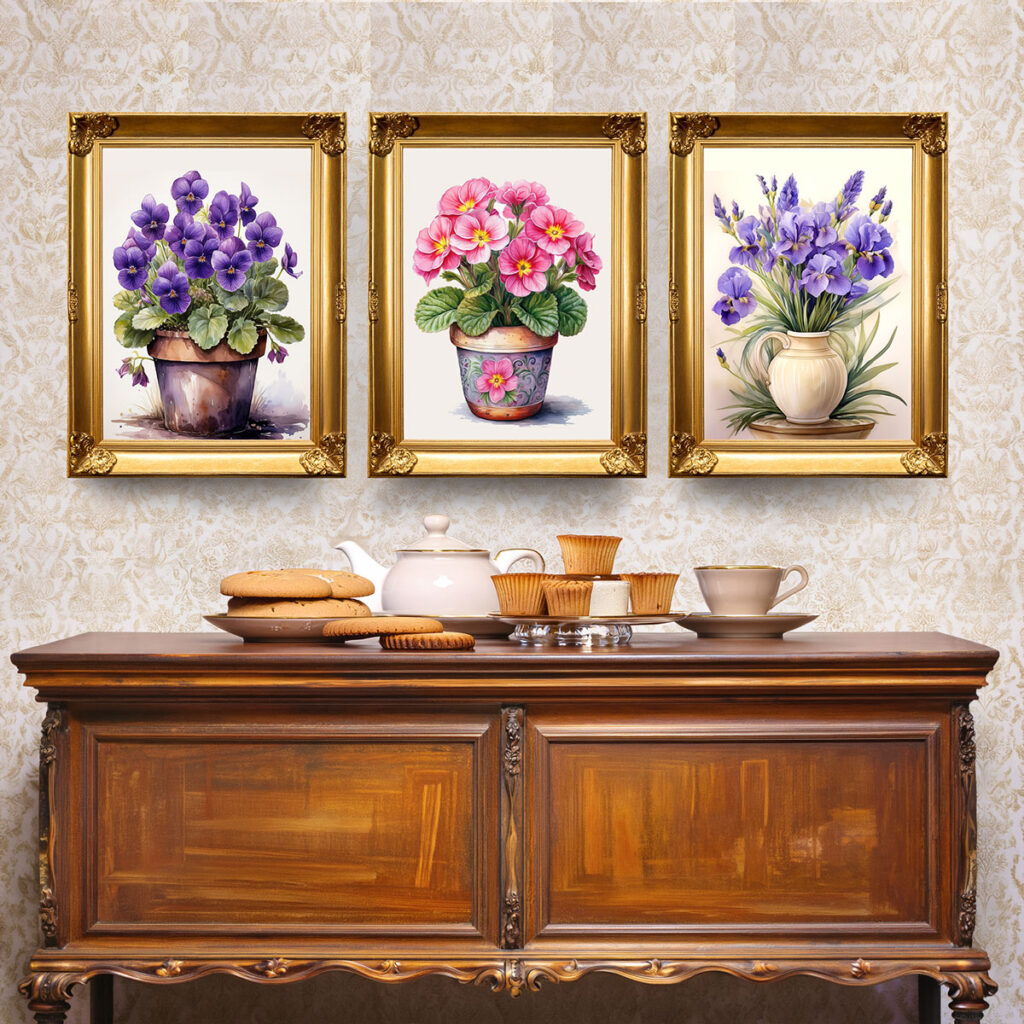
The Iris is a historically recent addition to February’s flowers. It symbolizes hope, wisdom, courage, faith, and admiration, and the promise of positive change. Irises are often linked to the Greek Goddess of the Rainbow, who traveled to deliver messages. Perhaps this is why Valentine’s Day in February holds its place there as a day of love and admiration. But really, Pope Gelasius I designated February 14th as Saint Valentine’s Day in 496 AD.
Since people born in February often forge ahead to accomplish their goals, the Iris is an appropriate symbol for them, as going forward often requires a leap of faith, courage, and undaunted hopefulness.
The Violet is February’s Primary Flower
It is no wonder Violets represent faithfulness, devotion, loyalty, modesty, and everlasting love, for these qualities are represented in many born in February. The gift of violets symbolized the giver to be always loyal and true, whether in friendship or love.
Still, the violet, as they say, can be a “shrinking violet,” but not due to a lack of courage; rather, they tend to keep low to the ground, portraying a sense of humility, grace, and the ability to watch from a less boastful perch. Because violets were historically purple, the color violet symbolizes royalty, loyalty, and truth.
In Greek mythology, violets were associated with Aphrodite and were believed to be her tears shed for Adonis. They were also the original flower of Valentine’s Day, since Saint Valentine used crushed violets to make ink. Next Valentine’s Day, why not use purple ink to write your cards? Include a little note to show how historically meaningful your love is.
Blue Violets symbolize faithfulness and devotion. White Violets are symbols of purity and innocence
White Violets stand for purity and innocence.
Pink Violets symbolize gentle, loving emotions, admiration, and innocence, representing youthful tenderness, friendship, and affection in a soft, romantic love that is ever new.
February’s Second Flower is the Primrose
Primroses symbolize young love, a renewed spirit, hope, and optimism. As one of the first flowers to bloom in late winter, they signify the arrival of spring and new beginnings. When you give a Primrose to someone, even a pretty picture of one, it means, “I can’t live without you.”
Primroses in Celtic and Irish Fairy Lore are considered gateways into a magical Fairy Realm where only happiness, joy, and grace can be present. What happens in this Fairy Realm? Only true friendship, harmony, peace, and the passion for every form of creative endeavor, such as art, dance, and literary wit. And of course, never forget soft, whimsical fashions portraying childhood innocence, frivolity, and fun.
Yellow Primroses are akin to great happiness and joy.
Pink Primroses are the epitome of grace and femininity.
Red Primroses mean the giver holds extreme passion and longing for you!
The Daffodil and Jonquil: March Flowers
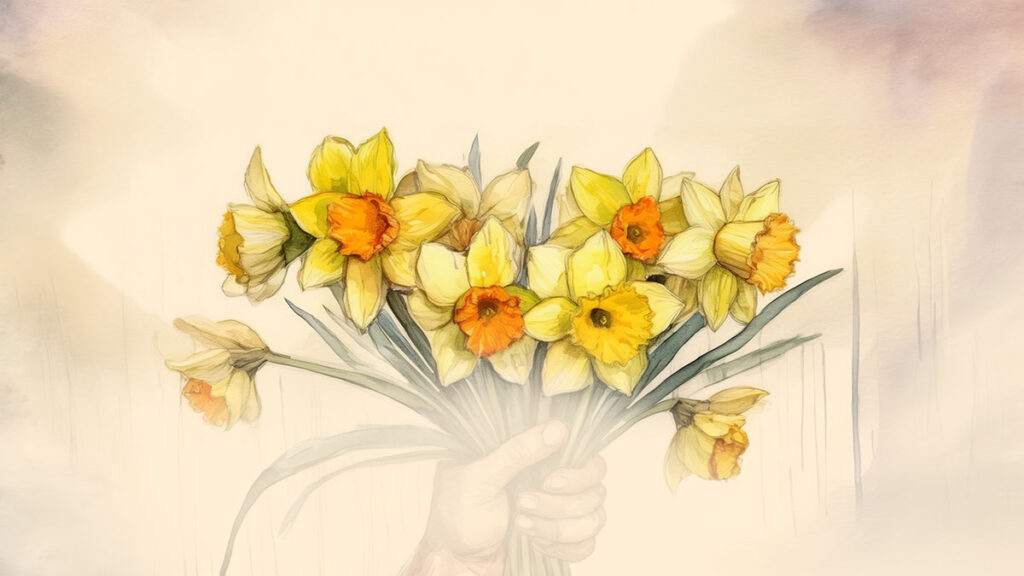
Daffodils are perfect symbols for March because they are among the first to bloom in early spring. Like snowdrops, they symbolize rebirth and new beginnings as well as Joy, Cheerfulness, prosperity, and good fortune. love, admiration, and faithfulness. Although March-born people are sometimes more love-giving than others, there can be a sense of unrequited love. But then they have so much love to give that another comes along in due course and wins their faithfulness. Daffodils are best known for their bright yellow blossoms, but also come in white, cream, and orange.
Daffodils are the national flower of Wales and are associated with St. David’s Day on March 1. If you are giving Daffodils, make sure you give a bunch, either cut or in a pot, since culturally, a gift of only one Daffodil is considered bad luck.
The Daffodil’s cousin, the Jonquil, represents an incurably optimistic attitude. Something we all need in down times.
Jonquils (Narcissus jonquilla) are not the same as Daffodils but are a specific type of daffodil of the Narcissus genus. Though all jonquils are daffodils, not all daffodils are jonquils; still, they are counted as March flowers. Jonquils have a more highly sweet fragrance, with clustered yellow flowers, sometimes as many as five per stem, and rounded, hollow, rush-like foliage, whereas typical daffodils usually have only one per stem. Their blooms are more delicately scented, with flat, sword-shaped leaves, and they prefer warmer climates like North Carolina’s.
Daffodils, irises, snowdrops, tulips, chrysanthemums, and lavender are gifted to express encouragement in times that are difficult to instill a renewal of faith, courage, and going forth with positivity. Their mere presence in your home, either fresh or in artwork, is like a constant reminder to be hopeful.
And then there is Spring!